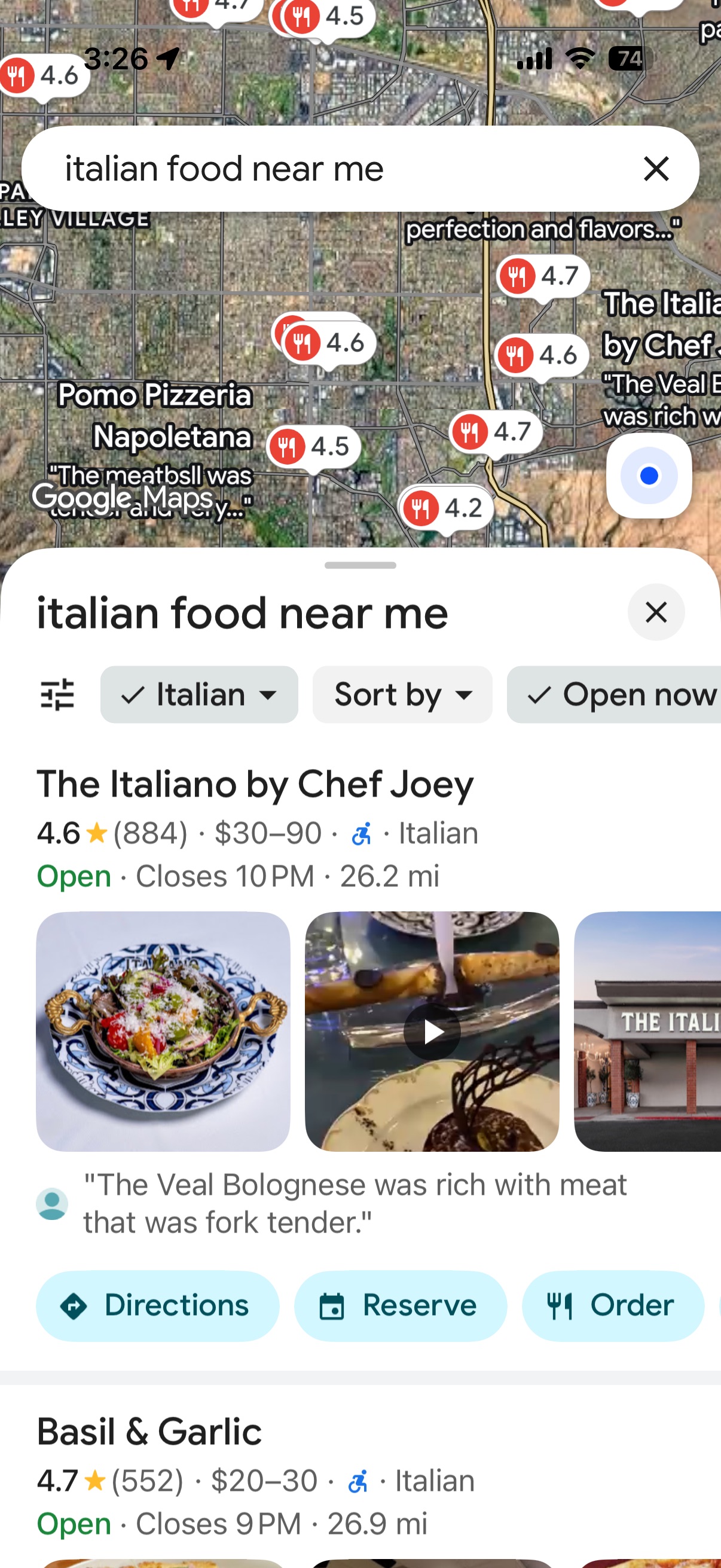
When someone within three miles searches “best ramen near me,” Google decides in milliseconds which three restaurants get the map spotlight — and which get buried below the fold. Local SEO is the discipline of being one of those three. Here is the complete 2026 playbook for restaurants.
Why local SEO is the highest-ROI marketing a restaurant can do
In Google’s own research, 76% of people who searched on their phone for something nearby visited a business within a day (Think with Google, 2016). For restaurants, “near me” searches are pure bottom-of-funnel — these people are hungry, close, and ready to spend. The local 3-pack sits above the regular results and draws a large share of the clicks, so the gap between rank #2 and rank #4 is often the difference between a full dining room and an empty one.
Google ranks local results on three pillars:
- Relevance — how well your profile matches the search
- Distance — how close you are to the searcher
- Prominence — how well-known and trusted you are (reviews, citations, links)
You can’t move your building, but you can dominate relevance and prominence. That’s where the work is.
You can’t move your building — so win on the two pillars you control: relevance and prominence.
Step 1: Perfect your Google Business Profile
Your Google Business Profile — your free business listing on Google Maps and Search. (GBP) is your single most important local asset — it powers the 3-pack and the map. Lock down every field:
- Correct primary category. Use the most specific one (“Mexican Restaurant,” not just “Restaurant”). Add secondary categories (“Taco Restaurant,” “Caterer”).
- Hours, including holiday hours. Wrong hours send diners to a locked door — a fast route to bad reviews and lost trust.
- Menu and online ordering links. Add your menu directly and link ordering.
- Photos. In BrightLocal’s 2019 study, listings with more than 100 photos got 520% more calls than the average listing. Keep adding fresh photos.
- Attributes (outdoor seating, vegan options, dog-friendly, accepts reservations) — these power filtered “near me” searches.
- Q&A and Google Posts — post weekly specials and events; it’s free real estate in your listing.
Here’s what separates a profile that ranks from one that gets buried:
- Specific primary + secondary categories
- Accurate hours, including holidays
- 100+ fresh photos, added weekly
- Menu + online-ordering links wired up
- Every review answered within 24h
- Generic “Restaurant” category
- Stale or wrong hours
- A handful of old photos
- No menu, no ordering link
- Reviews ignored
Step 2: Nail NAP consistency
NAP = Name, Address, Phone. Google cross-references your NAP across the entire web to confirm you’re legitimate. If your address says “Ave” on Yelp and “Avenue” on Facebook and “Av.” on your site, Google loses confidence and ranks you lower.
Audit and standardize your NAP — to the exact character — across: your website, Google, Yelp, Facebook, Apple Maps, TripAdvisor, Bing, and every food directory and delivery app. Inconsistent citations are one of the most common reasons good restaurants under-rank.
Step 3: Build review volume, velocity, and rating
Experts in Whitespark’s 2026 ranking-factors survey give review signals about 20% of the ranking-factor weight for the local pack — and reviews are one of the biggest signals you can influence directly. The targets:
- Rating: 4.4 stars or higher
- Volume: 100+ reviews to look established
- Velocity: a steady stream of fresh reviews every week (recency matters as much as count)
Ask every customer, make it a one-tap QR or text link, and respond to every review. (We wrote a full guide on this — it’s worth a separate read.)
Step 4: Make your website fast, mobile, and local
Many diners find you on their phone, and Google’s data found 53% of mobile site visits were abandoned when a page took longer than 3 seconds to load. Your site must:
- Load in under 3 seconds on a phone
- Have your NAP in the footer of every page and an embedded Google map
- Include a dedicated page per location if you have more than one (each targeting “[cuisine] in [neighborhood]”)
- Make the menu crawlable HTML text, not a PDF or an image (Google and AI engines can’t read a JPEG menu)
Step 5: Add restaurant schema markup
Schema is structured code that tells Google exactly what your page is. Add Restaurant schema (with servesCuisine, priceRange, openingHours, menu, and aggregateRating) plus LocalBusiness and Menu schema. This can make you eligible for rich results — star ratings, price, and hours showing directly in search. Google doesn’t guarantee them, but in its published case studies pages with structured data saw higher click-through — Rotten Tomatoes measured a 25% higher click-through rate.
Step 6: Earn local relevance with content and links
- Local content: a blog post like “The 7 Best Patios in [Your Town]” or “Where to Eat Before a [Local Team] Game” earns links and signals local relevance.
- Local backlinks: get listed by the neighborhood blog, the chamber of commerce, local “best of” roundups, and event sponsorships. A handful of genuine local links outweighs hundreds of spammy ones.
- Local press: a single feature in the city paper or food blog is a prominence rocket.
Your local SEO priority order
Run these top to bottom — the first three deliver the fastest wins; the last two compound into a moat competitors can’t easily copy.
Here’s the same plan as a quick-reference table:
| Priority | Lever | Timeframe |
|---|---|---|
| 1 | Complete & optimize Google Business Profile | Days |
| 2 | Fix NAP across all citations | 1–2 weeks |
| 3 | Launch the review engine | Ongoing |
| 4 | Speed up + localize the website | 2–4 weeks |
| 5 | Add Restaurant/Menu schema | 1 week |
| 6 | Local content + backlinks | 3–6 months |
Quick local SEO questions
Is local SEO different from regular SEO?
Yes — local SEO optimizes for map and 'near me' results using your Google Business Profile, NAP citations, and proximity signals, where regular SEO competes for standard blue-link results nationwide.
Can I do this myself?
The Google Business Profile and NAP cleanup are very doable solo. Reviews, schema, site speed, and local content take more time and tooling — which is where a partner like MorePie usually pays for itself.
Local SEO is a lot to run while you’re also running a kitchen. MorePie’s restaurant team does all of it for you — profile, citations, reviews, schema, site speed, and local content — and shows you exactly where you rank against your three closest competitors.
Want to own your local 3-pack?
We'll build your 90-day plan and show you where you rank against your three closest competitors.
Frequently asked questions
What is the Google local 3-pack? +
The local 3-pack is the block of three business listings Google shows with a map at the top of local search results — for example when someone searches 'tacos near me' or 'best pizza downtown.' It sits above the regular results and draws a large share of the clicks on the page, which is why landing in the 3-pack is the single highest-value goal in restaurant local SEO.
How long does local SEO take to work for a restaurant? +
It depends on how crowded your area is. Quick wins like fixing your Google Business Profile and NAP consistency can shift rankings within weeks, while reviews, backlinks, and local content compound over several months. Local SEO is a flywheel, not a switch.
What are the most important local ranking factors for restaurants? +
The three pillars Google weighs most are relevance (does your profile match the search), distance (proximity to the searcher), and prominence (reviews, citations, and links that signal popularity). In practice the highest-leverage levers are a complete Google Business Profile, review volume and velocity, NAP consistency across the web, and a fast mobile website.
Do I need a website if I have a Google Business Profile? +
Yes. A Google Business Profile alone caps your growth. Your website is where you add menu schema, location pages, blog content, and online ordering that Google and AI engines crawl to understand and rank you. The profile and the website reinforce each other — restaurants with both consistently out-rank those with only one.
Keep growing your business
See what this could do for your business.
Real numbers, a 90-day plan, no pressure — yours to keep.